@JohnBoehner—Why Is a Recently Convicted Cocaine User Serving in the U.S. Congress?

@JohnBoehner—Why Is a Recently Convicted Cocaine User Serving in the U.S. Congress?

“Our taxpayers don’t want to subsidize somebody’s drug addiction.” – Governor Scott (R-Florida). Unless, of course, that somebody is U.S. House of Representatives member Trey Radel (R-Florida) who was recently convicted of cocaine possession and is on one year probation. In his case, the Congressional GOP leadership thinks taxpayers should continue to subsidize him, and likely pay for his … Read more

We Have Passed the Economic Tipping Point in Achieving Marriage Equality

We Have Passed the Economic Tipping Point in Achieving Marriage Equality

A number of experts in law and state politics have written to emphasize the enormous slog that lies ahead for proponents of marriage equality.  As a lawyer who knows a bit about politics I share their concerns.  But employing my economics “hat” I wish to offer this encouragement – we have passed the tipping point … Read more

The Role of Financial Stress in the Sovereign Debt-Output Nexus, and in Economic Activity

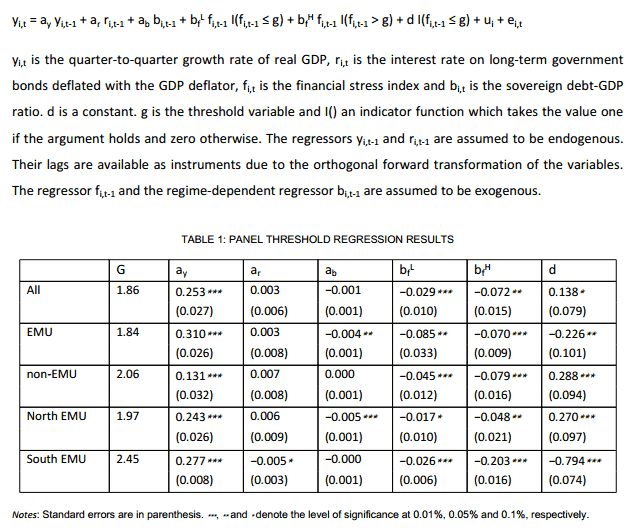
Since the outbreak of the euro area crisis, the link between a country’s macroeconomic performance and the level of its sovereign debt has become a central topic in the economic debate. Now, the recent showdown in the U.S. Congress over raising the country’s debt ceiling has made this issue central once again, not only for … Read more

The Perils of Zero Inflation for Swedish Household Debt

The Perils of Zero Inflation for Swedish Household Debt

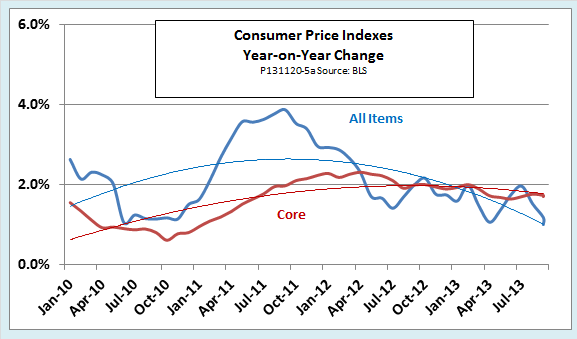
Zero inflation in Sweden the last two years instead of 2 percent, the inflation target, has substantially increased real household debt. Borrowers have made a real capital loss of 4 percent in two years, and lenders, the banks, have made a corresponding loss. The Riksbank’s “leaning against the wind” policy to reduce household debt is … Read more

Bow down to the Bubble: Larry Summerian Endorses Bubbleonian Madness and Paul Krugman Embraces the Hansenian Stagnation Thesis*

Bow down to the Bubble: Larry Summerian Endorses Bubbleonian Madness and Paul Krugman Embraces the Hansenian Stagnation Thesis*

Larry Summers has made a big splash by (finally) recognizing that the US has had a series of financial bubbles. Duh! Who wudduv thought? The Reagan years were just a bubble, driven by thrift excesses. The Clinton years were just a bubble, driven by dot-com excesses. And the most recent real estate boom and bust … Read more

Will the Chilean People Save the U.S. by Electing Michelle Bachelet?

Will the Chilean People Save the U.S. by Electing Michelle Bachelet?

For every one that doeth evil hateth the light, neither cometh to the light, lest his deeds should be reproved.  John: 3:20 The effort by corporate CEOs to dominate the global economy and global government is reaching the end-game stage.  Corporate CEOs view government and democracy as their gravest threats and are constantly seeking to … Read more

Q4:2013 US GDP Nowcast: +1.9%

Q4:2013 US GDP Nowcast: +1.9%

This year’s fourth-quarter US GDP is expected to increase 1.9% (real seasonally adjusted annual rate), according to The Capital Spectator’s average econometric nowcast. This is the initial estimate that uses limited Q4 data and so the projection is a preliminary review that will be updated several times as new economic indicators are published and existing … Read more

No ‘Hard Landing’ for Chinese Economy

No ‘Hard Landing’ for Chinese Economy

No “hard landing” for Chinese economy In the development economics there is a popular term of “hard landing”. It is contrasted with the “soft landing” defined as descending gradually and softly from high output growth levels, especially when the growth is related to an overheated economy. Hard landing means facing different realities as a result … Read more

What Should Be Done About Germany’s Current Account Surplus?

What Should Be Done About Germany’s Current Account Surplus?

On November 13, the European Commission released the Alert Mechanism Report (AMR) for 2014 as part of its annual cycle for identifying and addressing macroeconomic imbalances (the so-called Macroeconomic Imbalance Procedure). Based on a scorecard of macroeconomic indicators with indicative thresholds, the AMR identifies those countries for which an in-depth review of potential macroeconomic imbalances and corresponding … Read more