Libyan Investment Authority: What’s Next?

Libyan Investment Authority: What’s Next?

As Libya’s National Transitional Council (NTC) begins to take over the reins of power in the country, attention is turning to a series of governance issues, and immediately, where the funds are to come for the stabilization and reconstruction of Libya’s infrastructure after months of conflict. With the Qadhafi regime entrenched and crumbling, the allegations … Read more

Brazil: Exchange Rate Policy

Brazil: Exchange Rate Policy

The Brazilian Central Bank cannot aim at placing a floor for the depreciation of the real. The announcement, on May 22, that QE3 would be gradually tapered in the future led to a turmoil in international financial markets, as investors turned back to developed economies’ assets, giving way to a significant depreciation of the emerging … Read more

The Global Financial Crisis: No Lessons Learned

The Global Financial Crisis: No Lessons Learned

As a reminder, my blog addresses economic issues from the perspective of what is commonly called “modern money theory”. (As the great philosopher Yogi Berra said, “you can look it up”—or Google it.) However, the subjects tackled go far beyond the topic of monetary theory, hence, I also draw on other traditions including Keynesian theory, … Read more

Krugman and Helicopter Drops

Krugman and Helicopter Drops

The recent debate in the United States over helicopter drops and quantitative easing is very important.  It is, therefore, essential that sound economic logic is applied to separate out key issues. In ‘Helicopters Don’t Help (Wonkish)’, New York Times, 9 December, Paul Krugman compliments David Beckworth on trying to establish the irrelevance of ‘helicopter money’.  … Read more

QE, Rising Yields, and the Right Way to Taper

QE, Rising Yields, and the Right Way to Taper

Matthew O’Brien of The Atlantic gives us the 41 most important economic charts of 2013. The figures come from various contributors, including me. My figure is borrowed from chief economist Michael T. Darda of MKM Capital and shows that long-term treasury yields generally have risen under the QE programs. This pattern runs contrary to the stated objectives of … Read more

Helicopter Drops and Quantitative Easing Are Different

Helicopter Drops and Quantitative Easing Are Different

David Beckworth (‘The Wrong Debate: Helicopter Drops vs. Quantitative Easing’, EconoMonitor, December 10) leaves the impression that overt money financing is somehow the same as quantitative easing. He recommends that both approaches should involve a permanent increase in base money, and that both should be anchored to a nominal GDP level/target.  Such recommendations are, no … Read more

MMT: Often imitated, never duplicated*

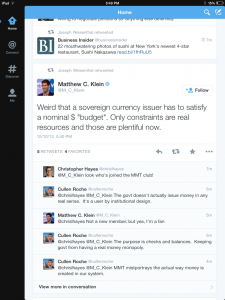
*From a Tweet by Stephanie Kelton. Today’s topic almost qualifies for the “you just can’t make this up” category. But first we need a bit of context. Some years back a guy named Cullen Roche came across our writings. (Disclosure: I still have no idea who he is but he apparently has had a blog … Read more

Christine Lagarde: Postcards From Asia

Christine Lagarde: Postcards From Asia

By Christine Lagarde—Managing Director, IMF: Cambodia: Moving Beyond the Frontier Cambodia is the first leg of my Asia trip. This is a country that has already grown by leaps and bounds, and now stands at the frontier of becoming an emerging market economy in the heart of the most dynamic hub of the global economy. … Read more

JP Morgan Chase and the Foreign Corrupt Practices Act

JP Morgan Chase and the Foreign Corrupt Practices Act

The Justice Department has just obtained documents showing that JPMorgan Chase, Wall Street’s biggest bank, has been hiring the children of China’s ruling elite in order to secure “existing and potential business opportunities” from Chinese government-run companies. “You all know I have always been a big believer of the Sons and Daughters program,” says one JP Morgan executive … Read more