
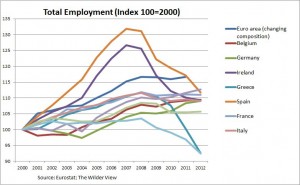
Eurostat released its annual detailed report of the labour force in Europe. I dug around a bit and found some interesting stats. The gist of what I found is the following: employment in the periphery markets has plummeted with no seeming end in site. Notably, 2012 employment levels in Portugal and Greece are 299,000 and 356,000 lower than their respective 2000 levels.
Note: Please click on all charts for a closer look.
Since 2009 (end of that recession), out of the EA11 (EA 12 less Luxembourg), 1.7 million jobs have been added regionally, while 3.2 million jobs have been lost. The balance is wholy uneven and skewed toward job loss. I expect this pace to pick up, as hoarding runs its course.
Since 2009, 5 countries added jobs with the heavyweight, Germany, accounting for 84% of the new jobs, while 6 countries cut employment with Spain accounting for 50% of that. Interestingly, the Italian labour market has only seen 169,000 jobs lost since 2009 despite seeing seven consecutive quarters of negative GDP growth as firms presumably hoard workers. Given the downbeat outlook for Italy, the employment statistics are likely to worsen materially in coming quarters.
Since 2000, the composition of employment in the euro area has shifted from craft, clerical support, and plant operators to service and sales, technician and associate professionals, and professionals across all countries with no obvious bias in the periphery over the core.
I thought that this was interesting: I had expected a sharp increase self-employment as a share of total employment in the perihpery economies, as the governments layoff workers and firms delever. This trend is only in its nascent stages. The trend of rising self emplomynet is there in Greece and the Netherlands (the Netherlands labour market is bleeding – see table above) but maybe only just beginning in Spain and Portugal. This could be the first official data that indicate growing shadow economies.
I see unhealthy developments across the euro area labour markets – developments that are not truly indicative of “rebalancing”.
Rebecca Wilder