Austerity and Growth: Dispelling Confusion With Some Facts
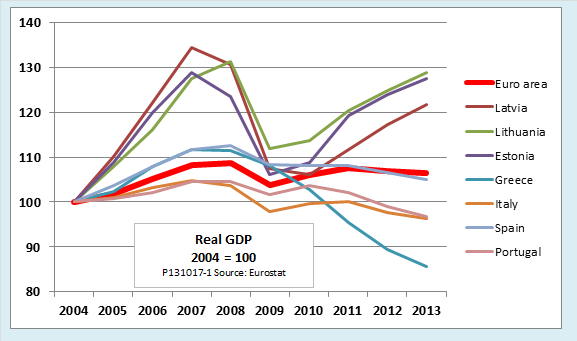
A lot of confusion surrounds the quarrel about austerity and growth in and among the Euro-countries. [1] Confusion helps neither the assessment of the current policies nor the choice of the correct ones. Critics of austerity argue that it is mainly responsibile for the extent and persistence of low or negative growth rates after the … Read more
Setting the Record Straight: BofA’s Rebecca Mairone Found Liable for Fraud

Setting the Record Straight: BofA’s Rebecca Mairone Found Liable for Fraud

Now here’s Poetic Justice. Back in the fall of 2010, Bill Black and I wrote a two part essay for the Huffington Post calling on Washington to go after the Foreclosure Fraudsters. Specifically, we pointed our fingers at the serial fraudsters at Bank of America. See here: http://www.huffingtonpost.com/william-k-black/foreclose-on-the-foreclos_b_772434.html, and here http://www.huffingtonpost.com/william-k-black/post_1115_b_772820.html?We argued it is time … Read more

A Billion-Dollar Opportunity for Developing Countries

A Billion-Dollar Opportunity for Developing Countries

With Håvard Halland. The decision last week by the Swiss government to sign the OECD’s somewhat lengthily named Convention on Mutual Administrative Assistance in Tax Matters is the latest of a series of developments that have radically increased the amount and quality of tax information available to governments. For developing countries, being able to access and … Read more

Money For Nothing: A Panel Discussion by Black, Kelton and Wray

Money For Nothing: A Panel Discussion by Black, Kelton and Wray

On the evening of October 21, 2013, there was a preview screening of the film “Money for Nothing” at the University of Missouri-Kansas City (UMKC). After the film, there was a panel discussion about the film with the filmmaker, Jim Bruce, and UMKC professors Dr. Stephanie Kelton, chair of the UMKC department of economics, economics professor … Read more

Closer to Colliding

Closer to Colliding

Each passing day brings the runaway trains closer to collision. The European strategy to scare the Greek people into voting for pro-austerity parties was always risky.  My tendency is to think it will drive voters in the other direction, this is especially the case if voters come to believe they hold the real leverage.  And … Read more

The Euro and the Sustainability of Current Account Imbalances

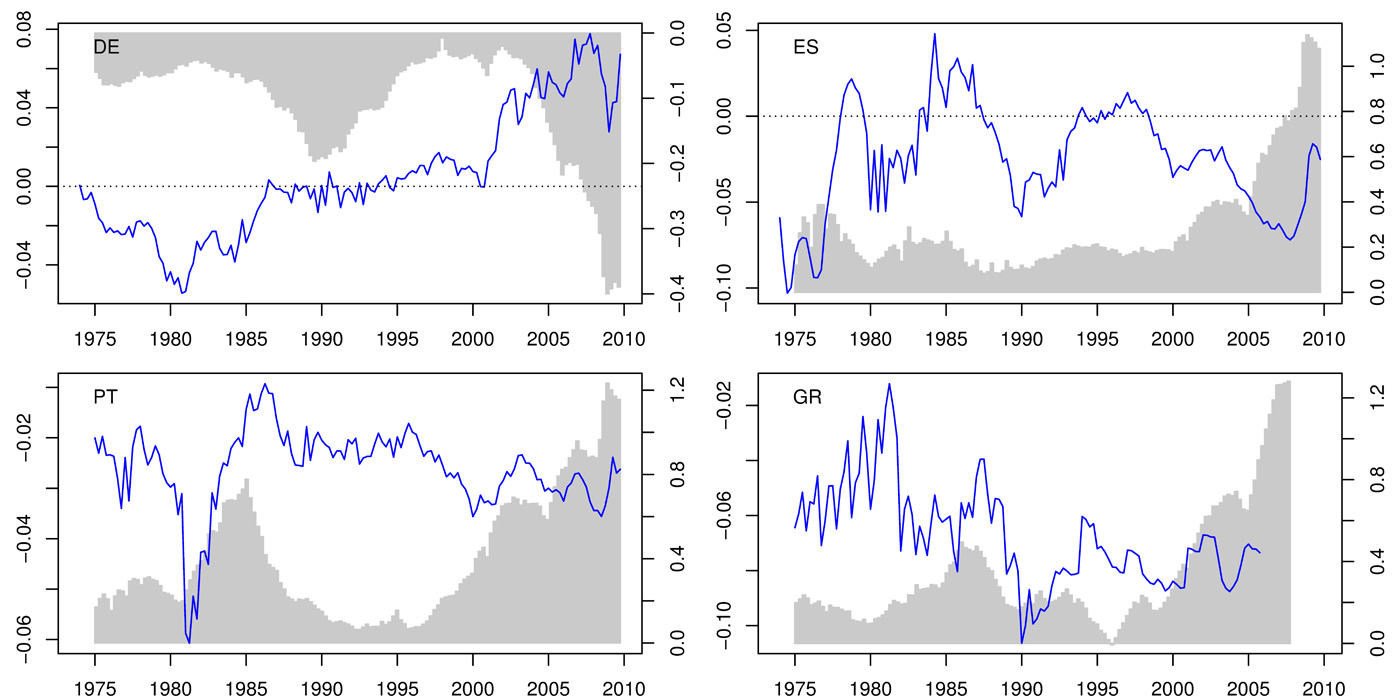
Summary: We analyze the sustainability of external debt of EMU members and the impact of the Euro on external imbalances. We find strong empirical support for the view that the present current account imbalances in the EMU are unsustainable and may jeopardize the long-run stability of the Euro Area. We also find that the introduction … Read more

Why the Baltic Recovery is Not a Success Story for Austerity: Lessons for the US

While EU members along the shores of the Mediterranean struggle with a seemingly endless slump, others who dip their toes in the Baltic are making a strong comeback. As the following chart shows, real GDP growth in the Baltic 3—Estonia, Latvia, and Lithuania—has recently run well above the euro area average. Meanwhile, the Med 4—Greece, … Read more

The Return of Europe’s Debt Crisis

The Return of Europe’s Debt Crisis

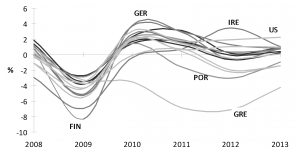
Since mid-2012, the European financial crisis has been in remission, with the symptoms of the underlying disease temporarily suppressed. As treatment is discontinued and drugs lose efficacy, there is a high probability of a relapse. Taking the Waters… A combination of austerity programs, debt write-downs, the European Central Bank’s (“ECB”) commitment to “do whatever it … Read more

Applying the Modigliani – Miller Theorem of Capital Structure to Governments: Why ‘Blue Bonds’ Are Not the Silver Bullet to Kill the Eurozone Debt Crisis

Applying the Modigliani – Miller Theorem of Capital Structure to Governments: Why ‘Blue Bonds’ Are Not the Silver Bullet to Kill the Eurozone Debt Crisis

In 1958 Merton Miller and Franco Modigliani published an article outlining the idea that in perfect capital markets the value of a company does not depend on its financing structure. The value of assets of a company does not increase if you raise the weight of debt in its financing structure, as the value of … Read more

Brazil’s Gross Debt and the Fiscal Stance

Brazil’s Gross Debt and the Fiscal Stance

The accounting tricks and the exaggerated expansion of government-owned banks have turned the gross debt into an indispensable indicator of fiscal stance. Recently, two international rating agencies, Moody’s and S&P, have signaled that their evaluation of the Brazilian economy has worsened. One of its main reasons is the public indebtedness’ evolution. There are two main … Read more