EconoMonitor

The Wilder View

Fractional Money Multipliers

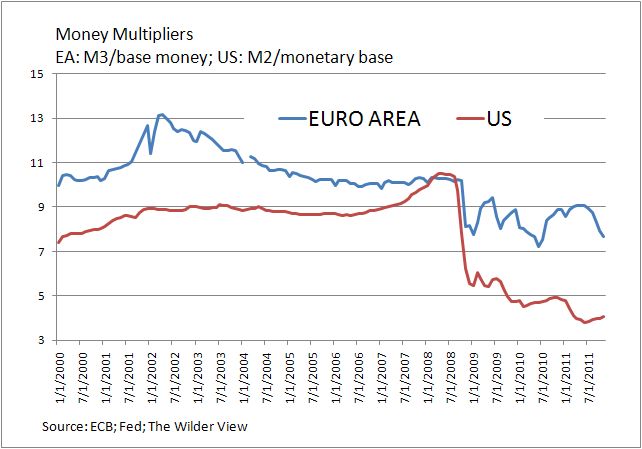
Money multipliers – the stock of money divided by a measure of base money (generally reserves plus currency in circulation) – are dwindling to fractions of what they used to be. FT Alphaville draws our attention to this fact on the Euro area (EA) using SocGen’s analysis. The money multiplier is a representation of how much credit is leaving the banking system via lending and growth (or inflation) enhancing monetary activities.

As FT Alphaville points out, the EA M3 multiplier is just over 3/4 its average 2007-2008 level, 7.67 vs 10.

But this is global! The US M2 money multiplier is a little over 2/5 the size of its average 2007-2008 level, 4.1 vs. 9.3. By this simple measure, I’d say that the US is in worse shape than is the EA.

Of note, my visual is a bit different from that in FT Alphaville. Specifically, I don’t agree with SocGen’s estimates that the EA money multiplier drops in December to roughly 6. Given that December 2011 EA base money has been published, a 6.2 M3 multiplier implies that M3 dropped by 15% in 1 month. That’s unlikely.

To my readers: There’s a 92% probability that I’ll be serving on a grand jury for the next three months. Since I’ll need to keep up with all matters EA, I’ll probably be blogging at a higher frequency and in less depth (like this one).

Rebecca Wilder

Source data: The Federal Reserve publishes money supply and monetary base data, which can be easily downloaded at the St. Louis Fred database. ECB data can be found here and here.

2 Responses to “Fractional Money Multipliers”

rwilder3January 4th, 2012 at 3:23 pm

If it were random. I have a 2/25 chance of getting out of it. I got out of it – had a very good excuse. I guess that it was not random after all. Rebecca

Leave a Response

Most Read | Featured | Popular

Blogger Spotlight

Edward Hugh Don't Shoot the Messenger

Congratulations to Edward Hugh whose EconoMonitor blog was #14 on CBNC's NetNet list of best alternative financial and economic blogs. Edward is a macro economist, who specializes in growth and productivity theory, demographic processes and their impact on macro performance, and the underlying dynamics of migration flows. Edward is based in Barcelona, and is currently engaged in research on aging, longevity, fertility and migration, and the impact of all of these on economic growth.

Economics Blog Aggregator

Our favorite economics blogs aggregated.