
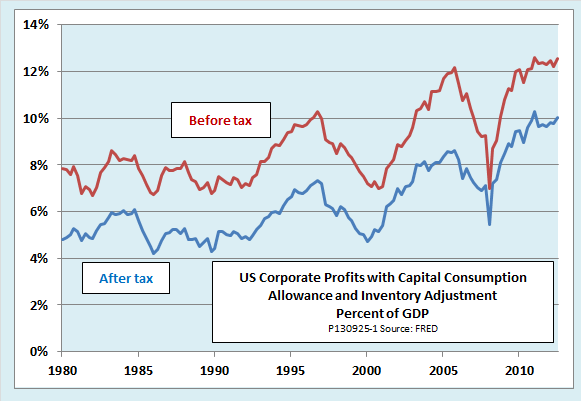

Meanwhile, proprietors’ income was flat in Q2. Popular discussions often treat proprietors’ income as a proxy for the income of small business. It includes the current income of unincorporated businesses that have the legal forms of proprietorships, partnerships, and tax-exempt cooperatives. It does not perfectly match up with small firm size because some small firms are incorporated and some proprietorships, partnerships, and cooperatives are large.

Proprietors’ income has lagged behind corporate income in recent decades. In the 1950s and 1960s, the shares of corporate profits and proprietors’ income were roughly the same. Now, corporate profits are half-again greater. The gap between the two hit an all-time high in Q4 2011, when corporate profits reached 168 percent of proprietors’ income. (This earlier post discussed some of the reasons for the increasing disparity between large and small-business profits, including changes over the years in tax and healthcare policy.)
The report on GDP and its components contained few surprises. Compared with August’s second estimate, today’s third estimate shows the same overall rate of growth of real GDP, at 2.5 percent. Inventory accumulation and the growth of exports were slightly less rapid than previously estimated. Those changes were offset by slightly faster growth of consumer spending and a slightly less rapid decrease in the government’s contribution to GDP.