Figuring Out ECRI’s Recession Call

Figuring Out ECRI’s Recession Call
I am writing this post in response to the article “Why Our Recession Call Stands” of March 15, 2012 by Lak­sh­man Achuthan and Anir­van Banerji of the Economic Cycle Research Institute (ECRI). ECRI said: “How about forward-looking indi­ca­tors? We find that year-over-year growth in ECRI’s Weekly Lead­ing Index (WLI) remains in a cycli­cal down­turn (top … Read more

We Have an Economic Recovery. It Costs $1.1 Trillion Per Year – and Might Still Fail

We Have an Economic Recovery. It Costs $1.1 Trillion Per Year – and Might Still Fail

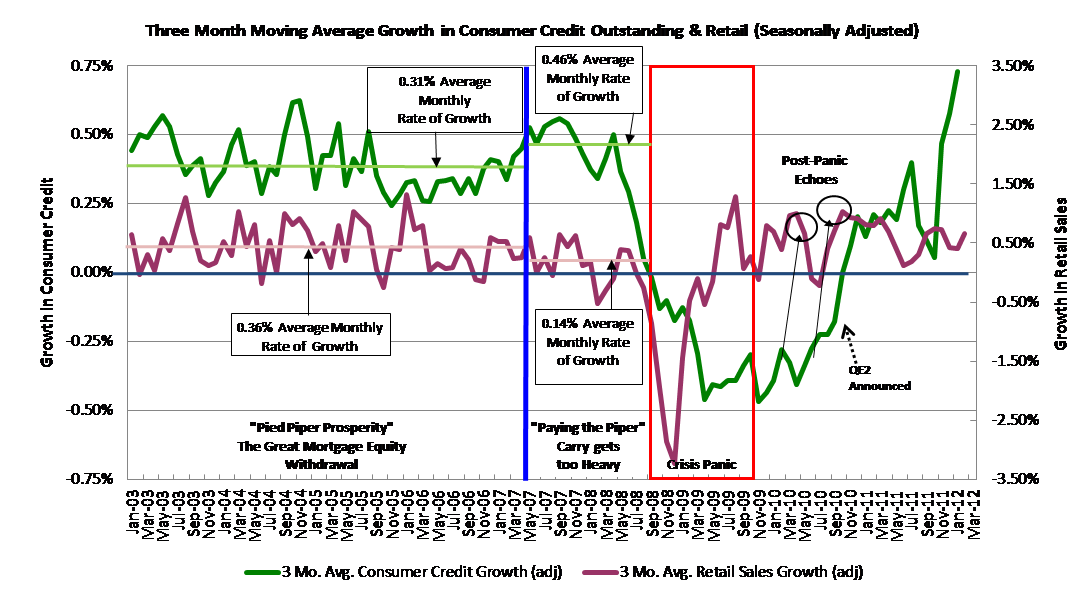
Summary:  Many economists and pseudo-experts forecast not just the long-anticipated “v” recovery, but an acceleration of the current good news into a boom.  Before we pop the corks, let’s look at the recovery, what the recovery cost us,  and how we’ve spent this expensively bought time. What happened in 2011? 1.8 million new jobs (from the current employment survey) Increase … Read more

Can Microcredit Lenders Fill the Gap?

Can Microcredit Lenders Fill the Gap?

The Chinese press is full of stories documenting the difficulties small and medium enterprises (SMEs) have obtaining financing. Contrary to popular belief, the problem is not that SMEs are being crowded out by large enterprises. The SME share of total business loans has been relatively stable in the past several years. Moreover, the pace of … Read more

A Colossal Mistake of Historic Proportions: The “JOBS” Bill

A Colossal Mistake of Historic Proportions: The “JOBS” Bill

From the 1970s until recently, Congress allowed and encouraged a great deal of financial market deregulation – allowing big banks to become larger, to expand their scope, and to take on more risks.  This legislative agenda was largely bipartisan, up to and including the effective repeal of the Glass-Steagall Act at the end of the … Read more

Housing Bubbles: Less Frothy but Europe is Behind

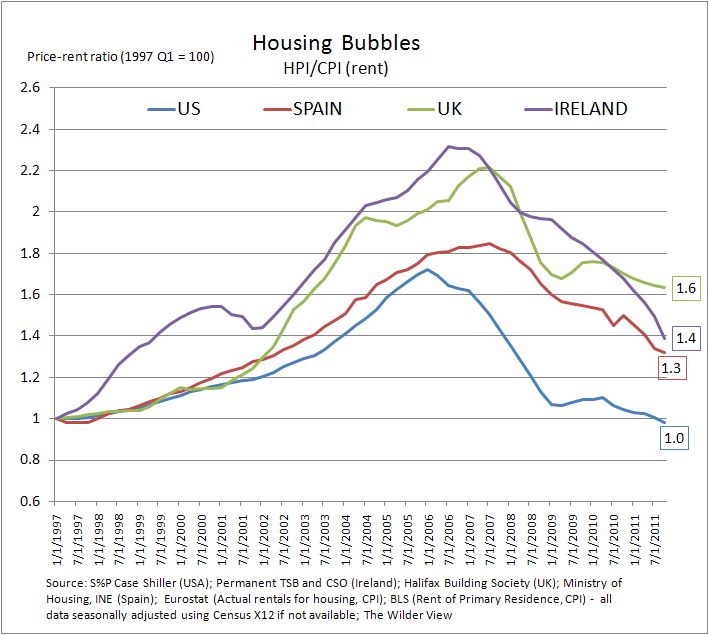
Wolfgang Muenchau’s article in the Financial Times, There is no Spanish siesta for the Eurozone, inspired me to update my post on housing bubbles around the world (really just Europe and the US). He argues that Spain’s bubble was much more extreme, and that the price adjustment is less mature compared to the others. I would … Read more

The Logic and Fairness of Greece’s Program

The Logic and Fairness of Greece’s Program

To get back to health, Greece needs two things. First, a lower debt burden. Second, improved economic competitiveness. The new program addresses both. Bringing down the debt Some countries have been able to work down heavy public debt burdens. Those that were successful did it through sustained high growth. But in Greece’s case, it had … Read more

Unconventional Policy or Unconventional Circumstances?

Unconventional Policy or Unconventional Circumstances?

Lots of bloggers have expressed lots of different views on what they consider interesting in Roger Lowenstein’s new profile of Federal Reserve Chairman Ben Bernanke in The Atlantic. Authors at The Big Picture, Free Exchange, Marginal Revolution, Modeled Behavior, and Real Time Economics, for example, all highlight distinct passages that piqued their individual interests. This … Read more

If You Took the Greed Out of Wall Street, All You’d Have Left Is Pavement: Why Greg Smith’s Critique Is Way Too Narrow

If You Took the Greed Out of Wall Street, All You’d Have Left Is Pavement: Why Greg Smith’s Critique Is Way Too Narrow

Greg Smith, a Goldman Sachs vice president, resigned his post Wednesday with a stinging public rebuke of the firm on the oped page of the New York Times — accusing it of no longer putting its clients before its own pecuniary goals. But if Mr. Smith believes his experience at Goldman is something new, he doesn’t know … Read more

Is the Risk Free Status of Euro Area Sovereign Debt in Tatters?

Is the Risk Free Status of Euro Area Sovereign Debt in Tatters?

In the first week of March, the euro area experienced the biggest sovereign debt restructuring in history and the first ever triggering of sovereign credit default swaps (CDSs) for an industrialized country. Yet nothing happened after these events struck Greece. It was a market non-event that was fully anticipated. For the often maligned euro area … Read more