Not Jackson Hole

Not Jackson Hole

Federal Reserve Chairman Ben Bernanke did not deliver another Jackson Hole speech in today’s testimony to the Senate.  Instead, he stuck to his usual style of delivering just the facts, or at least his version of the facts, and letting us pick apart the implications for monetary policy.  On on critical issue, the jobs report, … Read more

Follow-Up: Who Has the Most Debt in the US?

Follow-Up: Who Has the Most Debt in the US?

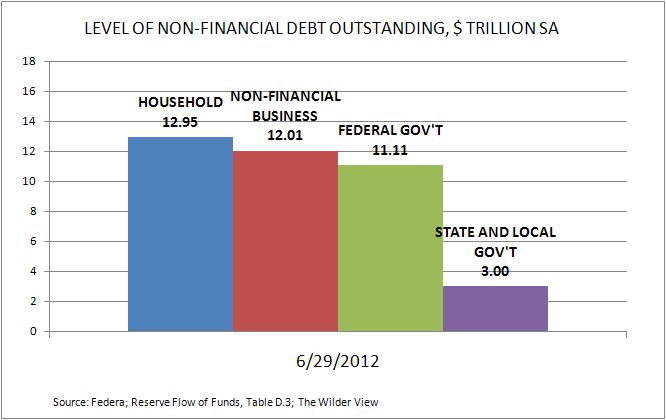
Yesterday’s post on US debt by sector brought up some interesting comments. Specifically, that there’s a stark difference between federal debt and private-sector debt (households and/or non-financial businesses). Household and non-financial business obligations are true liabilities in the sense that there’s a party on the other side that requires payment in a currency which must be … Read more

Who has the most debt in the US?

This was the question posed to a group of my colleagues as regards the merits of US fiscal and monetary policy: guess who has the most debt in the US economy? Everyone at the table said ‘the government’. When most pundits talk of ‘government debt’ they are inherently referring to federal government, who is not … Read more

Unemployment Rates Across the Euro Area – Tough Times in Key Markets

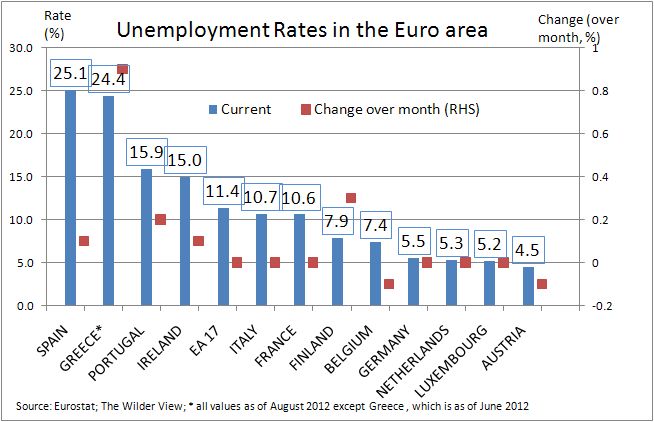
Today Eurostat released its unemployment rate figures for the month of August. The Euro area unemployment rate held firm at 11.4% for the third consecutive month. Spain still has the highest unemployment rate in the euro area, 25.1%, and Greece is catching up quickly, 24.4% (in June, which is the latest data point). The chart below illustrates … Read more

Latest GDP Revision Carries a Mixed Message for the Election: Economy Weak, but Corporate Profits Strong

Latest GDP Revision Carries a Mixed Message for the Election: Economy Weak, but Corporate Profits Strong

The revised third estimate of GDP for Q2 2012, released Thursday by the Bureau of Economic Analysis, carries a mixed message for the election campaign. The revised data show real GDP growing at an annual rate of just 1.3 percent in Q2, down from the already weak 1.7 percent of the previous estimate. The slowdown … Read more

Looming Demise of Wind Power Subsidy Shows the Need to Rethink Both Energy and Tax Policy

Looming Demise of Wind Power Subsidy Shows the Need to Rethink Both Energy and Tax Policy

Wind power has been a success story of green energy. After several years of rapid growth, it now accounts for about 3 percent of all electricity produced in the United States. It has benefitted from federal support, but that support is scheduled to end on December 31, throwing the industry into a crisis of layoffs … Read more

Is Mario Monti Going to be the ‘Next’ Italian Prime Minister?

Investors and political leaders around the world are very worried that the new government that will emerge from the next Italian elections in April 2013 will not be headed by Mario Monti, nor pursue the “Monti Agenda” of structural reform and fiscal discipline. The worries are well founded, for several reasons. Economics.. On one hand … Read more

The Bears Explain Where Money Comes From

The Bears Explain Where Money Comes From

I got an ugly reminder today of how some people are rabidly attached to the view that debt is the worst evil afflicting modern society (see what happens when you make it easy to get laid and make a boatload of mood altering drugs available with a prescription? The moralists focus their vitriol on the … Read more

Irrationality or delayed realisation? Empirical evidence on contagion

Irrationality or delayed realisation? Empirical evidence on contagion

If Greece defaults, what about Spain, what about the rest of the Eurozone, and what about the rest of Europe? “Contagion” has become a buzzword in international economics. This column asks whether markets are responding irrationally to the nightmare scenario or finally waking up to reality. “Contagion” is today’s buzzword (de Haan and Mink 2012, … Read more

Europe Still Heading For Collapse

Europe Still Heading For Collapse

The half-life of the effectiveness of European summits is growing increasingly shorter.  While I have been a long-term Europessimist, market participants are more willing to trade on whatever appears to be positive news, thus markets jump whenever it appears the Europeans are taking action.  But eventually the game will wear thin as market participants increasingly … Read more