Europe’s Stalemate

The causes of the present crisis of the European Union trace back to the past phases of the integration process.  In the 1980s, the series of agreements and common policies of “mutual advantage” among the EU members came to an end. Most economies of scale had been exploited by the EU countries, as an effect … Read more
The Geithner-Summers Plan Is Worse Than You Think

The Geithner-Summers Plan Is Worse Than You Think

The Geithner-And-Summers Plan (GASP) to buy toxic assets from the banks is rightly scorned as an unnecessary give-away by virtually every independent economist who has looked at it.  Its only friends are the Wall Street firms it is designed to bail out. In an earlier article, one of us (Sachs, FT, March 23) described the … Read more

Why QE in the Eurozone Is a Mistake

Why QE in the Eurozone Is a Mistake

Paul De Grauwe and Yuemei Ji (“Quantitative easing in the Eurozone”, VOX, 2015) have argued that quantitative easing (QE) can occur in the Eurozone without fiscal transfers.  This may be the case, but their analysis is fundamentally misplaced, as it is based on incorrect, incomplete or missing premises.  We think it would be a mistake for … Read more

How Globalization Helped Decreasing Inflation

How Globalization Helped Decreasing Inflation

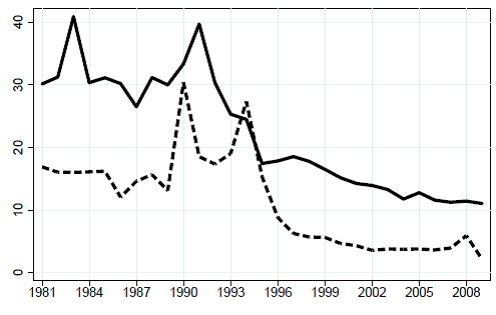
Globalization in the form of increasing international trade increases competition both within and across countries. This increase in competition has put pressure on prices, which slowed inflation. Globalization therefore helps to explain the “Global Disinflation”, the phenomenon of decreasing inflation levels, in the last 20 years. From 1990 to present, tariff rates around the world … Read more

The ECB Should Fully Use its Balance Sheet to Fight Deflation

The goal of this note is to support the view that the European Central Bank (ECB) should fully use its balance sheet to bring back inflation in the euro area to a reasonable level.  It comprises four recommendations, which are drawn from an analysis of the monetary policy pursued by the ECB and by the … Read more

Aging Demographics to Crunch Global Growth

Aging Demographics to Crunch Global Growth

Yves here. I don’t mean to make an object lesson of the author of this piece, van Onselen, since the point he is making, about demographics as a driver of growth, is valid from the vantage point he is taking (that of investment time horizons, which by nature are comparatively short). But this perspective is simultaneously frustrating … Read more

GCC: How to Create Jobs for Nationals?

GCC: How to Create Jobs for Nationals?

The GCC is growing, helped by crude production and expansionary policies. Despite the sluggish global outlook, the Eurozone recession, and Asia’s deceleration, the six Gulf Cooperation Council (GCC) countries – Bahrain, Kuwait, Oman, Qatar, Saudi Arabia, and the United Arab Emirates – are growing the fastest in the Middle East and North Africa (MENA) region … Read more

To G-20 Leaders: Urgent Need to Boost Demand in the Eurozone

To G-20 Leaders: Urgent Need to Boost Demand in the Eurozone

The economies in the Eurozone are continuing to slide into recession and depression.  Senior officials of G-20 countries (including those in Australia, the host government) have not understood, or anticipated, that the Eurozone crisis is a major threat to global recovery. The officials have provided sub-standard advice to their leaders.  The deepening crisis must be … Read more

Chinese Living Standards, International Perspective: The World Bank’s PPP Debate

Chinese Living Standards, International Perspective: The World Bank’s PPP Debate

Emerging economies are catching up with advanced economies, but differences of living standards remain far apart. A new report by the World Bank’s International Comparison Program (ICP) suggests that the purchasing power of China’s renminbi is significantly stronger than exchange rates indicate, based on 2011 prices. Measured by its currency’s purchasing power, the report concludes … Read more