MMT AND EXTERNAL CONSTRAINTS

MMT AND EXTERNAL CONSTRAINTS

To Fix or To Float, that is the question. MMT argues that a sovereign government that issues its own “nonconvertible” currency cannot become insolvent in terms of its own currency. It cannot be forced into involuntary default on its obligations denominated in its own currency. It can “afford” to buy anything for sale that is … Read more

Minsky on Banking: Early Work and Critiques by Krugman and Horizontalists Revisited

Minsky on Banking: Early Work and Critiques by Krugman and Horizontalists Revisited

Some quarter of a century ago I wrote a paper that presented Minsky’s approach to money, linking it to his Financial Instability Hypothesis. The paper was rejected by one of the heterodox journals, because a referee took particular issue with my use of the new word “securitize” adopted from Minsky to describe the packaging of … Read more

New IMF Paper Shows Yet Again that Reinhart and Rogoff Results Are Erroneous

New IMF Paper Shows Yet Again that Reinhart and Rogoff Results Are Erroneous

You all remember the Reinhart and Rogoff claim that debt ratios above 90% lead to slow economic growth. As Yeva Nersisyan and I showed in 2010, their results are crap. (see here http://www.levyinstitute.org/publications/?docid=1273) I’m pretty sure that the Reinhart and Rogoff “study” is the worst empirical research ever undertaken. They simply lumped together data of … Read more

Five Financial Questions for Ukraine

Five Financial Questions for Ukraine

There is an interesting debate going on in Western capitals over financial support for Ukraine.  The possibility of political change, coupled with Russia’s decision to suspend disbursements on its $12 billion financial package, has created an opening for meaningful economic reforms and renewed ties with global financial bodies.  There are compelling political arguments for the West to … Read more

Industrial Production: Another Turkish data puzzle

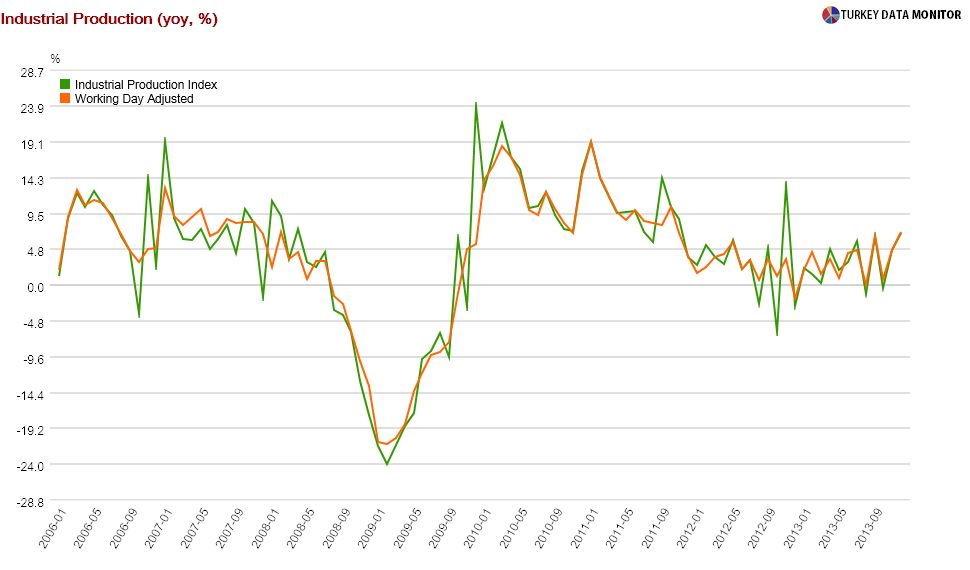
At 6.9 percent yoy, December industrial production (IP) came in much higher than expectations of 4.9 percent. Part of this is base effect; in fact, working day and seasonally-adjusted industrial production was unchanged over the previous month. However, machinery and equipment, which Turkey economists use as a leading indicator of investment, surged (red is yoy, … Read more

Revisiting Banking Union in a Single Currency Area (Part 2)

Revisiting Banking Union in a Single Currency Area (Part 2)

The current banking union framework remains far from ideal if the currency union dimension is taken into account. While decisions so far have been focusing on the moral hazard of banks, these measures fail to solve an additional market failure in the Euro area caused by the moral hazard of governments competing on funding costs, … Read more

The Eurozone’s ‘Nascent’ Recovery

The Eurozone’s ‘Nascent’ Recovery

By William K. Black On January 19, 2014 I posted a column entitled “Deflation: The Failed Macroeconomic Paradigm Plumbs New Depths of Self-Parody” that discussed the insanity of the Eurozone’s approach to “the threat of deflation.”  The EU’s troika cannot understand that deflation is produced by inadequate demand and that the way to prevent it is to use … Read more

The Trouble With Emerging Markets

The Trouble With Emerging Markets

LAGOS – The financial turmoil that hit emerging-market economies last spring, following the US Federal Reserve’s “taper tantrum” over its quantitative-easing (QE) policy, has returned with a vengeance. This time, the trigger was a confluence of several events: a currency crisis in Argentina, where the authorities stopped intervening in the forex markets to prevent the … Read more