
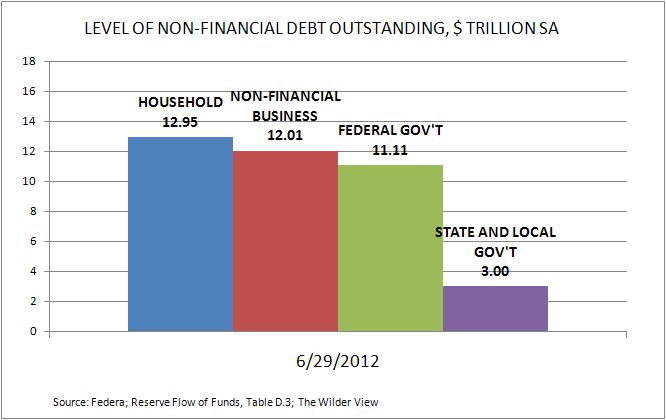
This was the question posed to a group of my colleagues as regards the merits of US fiscal and monetary policy: guess who has the most debt in the US economy? Everyone at the table said ‘the government’. When most pundits talk of ‘government debt’ they are inherently referring to federal government, who is not the highest explicit debtor in the non-financial US economy (total nominal debt outstanding excluding financial and foreign financial domestic debt outstanding).
Coming to the answer of this question can be rather complicated.
According to the Federal Reserve’s latest flow of funds accounts (see Table D.3 in the following .pdf link), federal debt outstanding was $11.11 trillion. US household debt and US non-financial business debt outstanding were each greater: $12.95 and $12.01 trillion, respectively. Here, the US federal government does not have the largest stock of debt outstanding.

Well, you may then say the following: look at the general government, or the public sector which includes the US federal government plus state and local governments. The public sector (general government) does have the largest stock of debt outstanding, $ 14.11 trillion. But for a comparable analysis, then one needs to consider the ‘private sector’, which includes household plus non-financial business debt outstanding. Private debt outstanding dwarfs that of the public sector debt outstanding: $24.95 trillion vs. $14.11 trillion, respectively.

While the US federal government is popularized as being the largest debtor in the US economy, it’s not. Look at the time series in natural logs – by taking the natural logarithm of the public and private debt outstanding series, the slope of the line is a growth rate. I’ve put the two on different axis, so this chart is not precisely correct; but the trajectory of government debt took another leg upward on Q1 2008 at the outset of private sector deleveraging. Better put: the government is ‘financing’ the private sector’s desire to save.
So outside of default or inflation, the government does bear the ultimate burden of private sector debt.

Clearly there are legacy issues with the federal government debt overhang – wars, wealth taxing policies, etc. But the entire story of debt burden includes a large share felt by the private sector; this often goes unnoticed when bringing up ‘debt’.
Another part of the story for the US federal government that is bound to come up in a discussion of public debt is the GSEs and contingent mortgage liabilities for the government. The government’s responsible, either explicitly or implicitly, for about $5 trillion of mortgages outstanding – this is not included under the ‘federal government’ debt outstanding above. To that I would reference the $16.1 trillion in financial debt outstanding (domestic financial plus foreign debt outstanding in Table D.3), of which GSE-backed mortgage pools are a function. There’s still quite a bit of financial leverage in the private sector. In the 1980s, the stock of financial debt outstanding was 22.1% of the total non-financial debt outstanding. Today, financial debt is 41.3% of total non-financial debt, and that’s down from a peak of 56.7% in Q2 2008.
Debt is a complicated story. What’s less complicated is that there’s too much of it.
Rebecca Wilder