
“Population, when unchecked, increases in a geometrical ratio. Subsistence increases only in an arithmetical ratio. A slight acquaintance with numbers will show the immensity of the first power in comparison to the second.”
Essentially, population increases geometrically: 1, 2, 4, 8, 16, 32, and so on. Yet food production only grows arithmetically: 1, 2, 3, 4, 5, 6, and the like. The problem then becomes quite clear; food production cannot keep up with population, limiting its growth. And indeed, this theory helped explain limited population growth for the following 150 or so years until industrialization and the Green Revolution led to rapid increases in food production capability.
The problem with Malthus’ theory, easy to see now, is that it does not take technology into consideration. With technological advancement, mankind was able to make geometric food production gains to keep up with the increasing caloric needs of a growing population.
A new “Malthusian Catastrophe” may be on the horizon, however. The trouble won’t be inadequate food supplies in the same way it was in Malthus’ day, but rather an inability to produce and balance distribution of resources for two competing needs: food and energy.
This problem is global, and as one can imagine, some regions are better positioned to prevent a Malthusian Catastrophe than others. With cooperation and coordination, chances are few countries will face this situation. Yet each country faces its own specific challenges in ensuring that adequate food and energy are produced. In the following paragraphs, I will address issues relevant to the US, though be aware that a post like this could be written for every country.
The US is facing an increasing supply constraint of essential agricultural products like corn. Corn is a great example of understanding this resource war between food and energy, and is the most important crop as it represents 90% of US feed grain production. This country has placed a heavy emphasis on biofuel production, a major destination for corn, while many routine household food products contain significant amounts of corn-based products, increasing demand for corn in both sectors.
This demand has motivated many a farmer to convert land to corn production. While total land devoted to feed crops declined by 10% between 1963 and 2007, the amount of land dedicated to corn rose by 36%. This year’s draught exposed the conflict over competing usages of corn. Lower corn yields meant that a greater portion of production had to go to producing the mandated amounts of ethanol, leaving less available for food production, driving up food prices worldwide. When this year’s numbers come out, Neil Conklin, president of Farm Foundation, believes they will show that 40-50% of 2012’s corn production will have gone to energy, a new high.
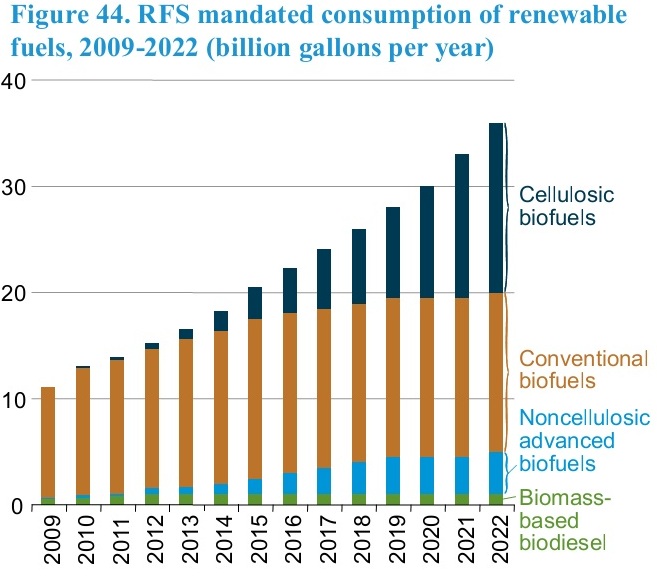
This chart (page 44) shows mandated consumption of biofuels in the US from 2009 to 2022 and their composition, which means US farmers will have sufficient motivation to dedicate increasing amounts of their crops, corn and otherwise, to energy production; 40-50% will not be an unusual figure in the future given current corn acreage.

Energy demand in general will rise as well. Historically speaking, the better the economy is doing, the more energy we consume (although the rate of growth is declining significantly). As the goal of economic policy is prolonged growth, we must assume energy demand will also grow so long as the economy continues to expand. As we’re discussing agriculture here, we’re concerned about alternative energy sources. The Energy Information Agency produces annual projections. Notice that the most substantial growth comes in renewables:

Meanwhile, the US population remains the world’s fastest growing among industrialized nations, meaning the caloric needs of the country are not insignificant. Despite a rapid rise in obesity, however, average caloric intake has remained relatively stable since over the last 15-odd years, with 2008 consumption nearly the same as 1999 consumption. Still, even stable intake applied to a growing population means rising food production requirements. Worldwide, the Food and Agriculture Organization predicts that production must grow by 70% by 2050 in order to feed the world population that year.
Beyond the domestic market, agricultural exports are an important income stream for the US agriculture sector, and an important import for many countries. Agriculture is one of the positive areas of our trade balance, having logged seventy straight months of positive trade balance. For 2013, the USDA forecasts record export value on strong demand from Japan, Canada, and Europe, and rising commodity prices.
A key, then, to meeting agricultural demand is what it has been before: technology. If demand of corn and other agricultural products is rising across competing markets, production must rise in order to avoid a Malthusian-type catastrophe where population growth drags from malnutrition. Technological progress led to rapid population (and standards of living) growth before, and it can be leveraged again to ensure population and resource sustainability.
The productivity challenge we face is a very difficult one. There are two ways in which to increase production. The first is by extensive growth, or the increase in inputs. Extensive growth ramps up existing inputs for quick productivity gains, but it produces diminishing returns and is unable to meet geometrically scaling needs, to use Malthus’ terminology. The other way to increase production is through intensive growth, the expansion of scales of production. One way to measure intensive growth is with Total Factor Productivity (TFP), which accounts for output not caused by the traditional inputs of extensive growth (labor and capital). Essentially, TFP measures output attributable to technology.
The United States Department of Agriculture measures the total factor productivity (TFP) of American agriculture, and the numbers are not promising. This is especially concerning because TFP is what has historically driven long-term progress in agriculture. The pace of TFP improvements has slowed steadily and dramatically. Between 1970 and 1990, annual productivity growth in wheat, maize (corn), and rice was 2%. Between 1990 and 2007, it was 1.1%. Between 2007 and a projected 2014, it will decline to 0.8%.
TFP growth in industrialized countries has accounted for essentially all agricultural growth over the last 50 years worldwide, according to remarks by USDA’s Keith Fuglie at a Farm Foundation event on Wednesday. Lately, China, India, and especially Brazil have really ramped up their productivity while Sub-Saharan Africa is experiencing anemic growth. There has been a very positive productivity recovery in the former USSR states driven primarily by TFP. Within countries, even, there are large discrepancies between states or provinces. The Great Plains states, for example, are doing significantly better than other agricultural states.
TFP does not improve overnight; the lag time between investment and payoff is substantial. Significant growth in US spending on agricultural research and development and transportation and irrigation infrastructure in the 1970s and 1980s did not pay off until the 1990s and 2000s. Brazil began making significant investments in the 1970s and 1980s and are now the second largest agriculture player in the international market, but only relatively recently did they enter the realm of heavy global hitters.
Yet today, investment in the agriculture sector is declining in developed countries while it is increasing in developing countries according to Fuglie. Private R&D tends to follow public R&D when it comes to agriculture, as public R&D produces the basic science the private sector than uses to create advancements (think public funding for biotechnology in the 1990s). Fuglie emphasized that there is substantial evidence (see this and this for two examples) that links investment in research to long-term productivity growth and warned that stagnating investment in America has only begun to show its potential for reduced TFP growth. In general, countries that invest the most in terms of amount per agricultural worker do the best job of feeding their people.
So productivity growth is lagging, but our demands on it are multiplying in variety and rising in aggregate. This is a reincarnation of the Malthusian theory of population where eventually a tipping point is reached and populations can no longer support themselves. When approaching this point previously, technology was our way out. There is no reason technology cannot help this time, too.
There is an on-going debate about how to stimulate productivity growth. Is the solution more government R&D funding, is it fewer market—distorting policies like the ethanol mandate? The consensus in the National Press Club room on Wednesday where the Farm Foundation helped the OECD launch its Agriculture Policy: Monitoring and Evaluation 2012 report was more supply-side policies and decoupling of policy from production.
According to speakers from the Farm Foundation, OECD, USDA, and the World Bank, efforts need to focus on enabling efforts to support innovation and stimulate productivity, and should be approached from the supply side where less market-distortion occurs. I’m no agriculture expert, so I will refrain from attempting to make specific recommendations on how to improve agricultural productivity. I do encourage you to read the new OECD report which includes detailed analysis and recommendations.
The election means the farm bill awaiting passage in Congress likely will wait until after the election or even 2013, but now is a good time to start thinking about where we are going with our agriculture and energy policies. If the farm bill expires this year, we will revert to the 1949 bill. This would mean a return to bigger bonuses for some farmers and less, or none, for others, depending on products cultivated. The current bill expires at the end of September, but many of the kind of market changers from the 1949 bill will not go into effect until January 1, 2013. This is big, for the industry, the consumer (some are warning of $38 milk), and the economy at-large (the USDA says that one in twelve US jobs are linked to the farm). Meanwhile, both presidential candidates are stuck on the misleading and unhelpful concept of energy independence that lacks intelligent thinking about energy policy.
Malthus was an important voice in the development of economics and public policy during his life. Today many forget him because the theory he is best known for missed what for modern times became a very obvious fact of life. Yet the crossroads we face with our agricultural needs in feeding people and fueling their standards of living with energy means our ability thus far to stave off the Malthusian catastrophe needs to be revisited.