
Her points are well taken. I look at this draft proposal and wonder how can they credibly attack any of these issues in detail at the 18-19 October Summit. I digress and expand on Megan’s statement:
The German government has signaled support for rerouting taxes (including corporate and value added tax) to Brussels. How will the German (and Dutch, Austrian, and Finnish) electorate feel about this when they are paying higher taxes that are then redistributed not only to basket cases like Greece but also to Ireland, which benefits hugely from a low corporate tax rate?
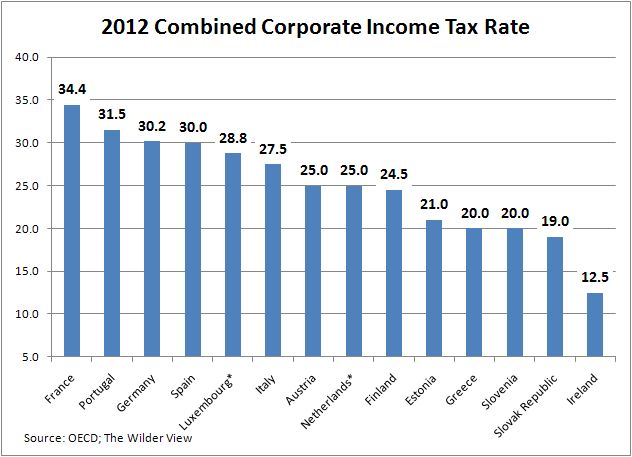
There are two additional points worth noting. First, of the 15-odd euro area countries that are listed in the OECD tax database, Ireland has the lowest corporate tax rate in 2012. However, as regards the 2011 cross-country VAT tax rates, the Irish rate ranks the 5th highest.
Exhibit 1: 2012 Corporate Income Tax Rates

Exhibit 2: 2011 VAT Rates

Normalizing taxes across national borders will be a difficult task. One would need to establish a ‘federal rate’, thereby allowing the 17 municipalities (countries) flexibility to set their own policies but with bound budgets (i.e., no support for local, or municipal budgets).
This brings me to my next point. To my knowledge, it’s not clear whether Rompuy is proposing a pan-euro taxing authority or simply subsidizing the budget with national contributions. This makes a difference. A pan-euro taxing structure would be much more opaque, whereas national contributions would be more widely televised. I suspect that the issue of redistribution of tax payments from core to periphery economies (see Megan’s point above) would be less meaningful if the budget was funded via a federal tax net rather than national contributions.
Have a wonderful weekend! Rebecca Wilder