

On the other hand, economies these days are much more organic, being capable of one way or another to direct resources (or excess of resources) to more productive activities that letting them sit idle. One of these ‘automatic stabilizers’ so to speak is the shadow economy.
It is true that neither Spain nor Greece had unemployment levels anywhere near to what Americans or the Japanese are used to seeing, with precrisis troughs in both countries in the low-10s. But when the things got really tough, both unfortunately saw unemployment more than double, with other EU peers witnessing similar dynamics.
At the same time, shadow economies expanded across the region. While it does have economic costs for countries, it also relieves some social hardships for laborers. Indeed, we’ve heard and read stories about people finding some consolation in the shadow economy.
But can such a system be sufficient? Could the shadow accommodate this excess? Well, let’s look at the numbers.
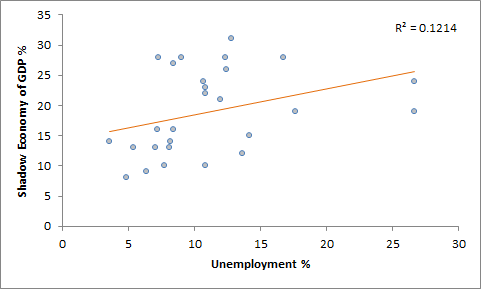
Source: Eurostat, The Shadow Economy in Europe 2013
The above scatter shows the relation between unemployment and the size of shadow economy for 27 countries in Europe. And while the direction was expected, the strength of the correlation is much weaker.
But let’s make no mistake, as Obama puts it, the data does not indicate that laborers don’t turn to shadow activity in a high unemployment environment. Rather, I think that it might hint that the shadow economy only serves as partial rescue for them. The problem is there is no other part. While they could use unemployment benefits for their income, that puts tremendous pressure on governments and in times of austerity mania, the end of allowances will return with budget cuts, meaning more social suffering. After all, it’s a zero-sum game, right?
The dynamics support the claim, especially for the cases of Spain and Greece. Even when the rise of unemployment kept its pace, the shadow economy in fact detracted among these two, albeit slowly (look at the picture below).
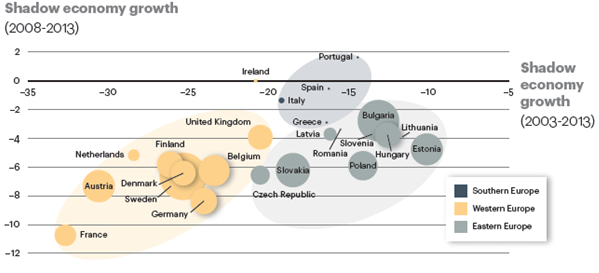
Source: The Shadow Economy in Europe 2013
The above data could mean that they just made less money in the unaccounted part of the economy, but that’s even worse, right? From personal perspective, of course.
Thus, I don’t think that an excess of resources, the human capital, is deployed in the shadow economy. Europe’s labor market seems to be in very deep trouble, and even if some residents can supplement or even substitute their lost income by working in the shadow economy, the rest of the unemployed clearly cannot.