
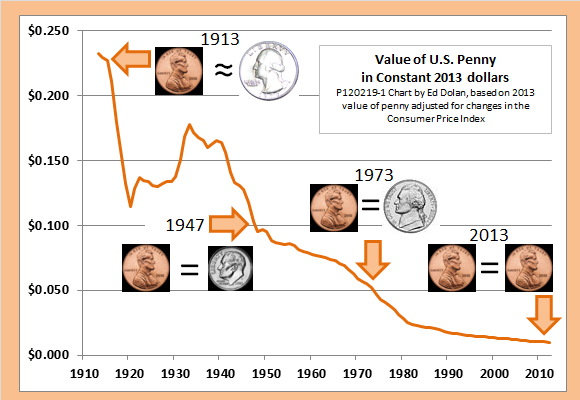
What we have not always had is a coin as small in value as the current U.S. cent. In fact, we never have had a coin worth so little. Take a guess at how much a penny was worth, in today’s money, in the year you were born. Then check your answer against the following chart, which shows just how much that little sliver of copper and zinc has shrunk in value over time:

Look at it this way:
- If we got rid of the penny, our smallest coin would be the nickel. That would take us back to where we were in 1973.
- If we got rid of the penny and the nickel, our smallest coin would be the dime. That would take us back to 1947.
- If we got rid of the penny, the nickel, and the dime, our smallest coin would be the quarter. That would take us back approximately to where we were from 1857, when the last half-penny was minted, up to the First World War.
Back when the penny was worth so much, was there a public outcry demanding smaller coins? Not really. In the depths of the Depression, when the value of the penny peaked at about 15 cents in today’s money, the Treasury actually proposed issuing half-cent and 1-mill coins. The idea was quickly shot down, and the coins were never minted.
Today, who wants to keep the penny, and why? The pro-penny group Americans for Common Cents is reportedly funded by the zinc lobby. That stands to reason, since the penny has been 95 percent zinc since 1983. Coinstar, Inc., is another avid backer of the penny. They make the automatic coin counting machines you sometimes see in supermarkets. The two sometimes have a hard time presenting a common front. Americans for Common Cents claims that 66 percent of Americans favor keeping the penny. However, Coinstar’s polling shows that 31 percent of those polled want to keep the penny only if it can be made of something cheaper than zinc, which now pushes the cost per coin well over one cent. According to their numbers, only a minority want to leave the penny as it is.
Industry lobbying aside, it seems that people’s biggest fear is that rounding of prices after elimination of the penny would lead to inflation. For three reasons, that is unlikely.
First, the United States, like Canada and other countries that have eliminated small-denomination coins, would undoubtedly issue rules to regulate rounding. Canadian rules require that cash transactions be rounded down for amounts ending in $.01 and $.02, and up for amounts ending in $.03 and $.04. The rounding would occur at the cash register. Nothing would prevent merchants from posting prices in one-cent increments, and marketing considerations would discourage the rounding up of posted prices. Retailers would probably continue to set prices at “price points” like $2.99, which consumers are thought to perceive as much cheaper than an even $3. In much the same way, even though there are no one-mill coins, U.S. gas stations post prices like $3.859 in order to get an edge over any competitor who would be foolish enough to price at $3.86.
To understand how rounding would work, suppose you go into a convenience store and buy a can of cat food for $1.59, a dozen eggs for $2.59, and a soda for $.99. Your total bill comes to $5.17. If you pay cash, that would be rounded to $5.15, saving you two cents.
Second, keep in mind that rounding applies only to cash transactions. If you pay by check, credit card, or debit card, you would pay $5.17 for your cat food, eggs, and soda, the same as now. In the United States today, cash payments account for only about 0.2 percent of all transactions. Even if we leave out the kind of wire transfers used to settle large financial transactions, the share of cash still is only about 2.4 percent. If every merchant in the land cheated on the rounding rules for cash transactions, it would not have a measurable impact on inflation.
Third, as any economist will tell you, the rate of inflation has nothing at all to do with the size of the coins a country has. Even if rounding to the nearest nickel produced a transitional impact on prices, it would be confined to a very short period. Over any significant time horizon, the rate of inflation depends on macroeconomic factors such as fiscal and monetary policy, productivity growth, and exchange rates, none of which would be at all affected by a change in the coinage.
Suppose the worst case—everyone cheats on the rounding rules and the average retail price of goods and services jumps by an extra 1 percent in the month the penny goes out of circulation. So what? If all the macroeconomic factors were to remain the same, inflation over the next few months would be 1 percent less than it otherwise would have been. By the time a year had passed, the overall price level would be no higher or lower with or without the penny.
Let’s not just theorize, though. Let’s watch what happens next door in Canada, which stopped putting new pennies into circulation this month. Give it a year. If there is a big spike in Canadian inflation that is traceable to the end of the maple-leaf penny, then we can keep our Lincoln cent. If getting rid of the penny fails to turn Canada into Zimbabwe with polar bears, then we can follow their example.