
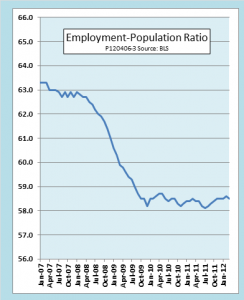
What does legalization of marijuana have to do with the employment ratio? More than you might think, and marijuana itself is just the tip of the iceberg. The United States has the highest incarceration rate in the world, something like 750 per 100,000 of population. About two-thirds of those are in federal and state prisons, the rest in local jails. That is forty percent more than Russia, 50 percent more than Cuba, and almost three times as many as Mexico—none of them places we would not like to emulate. It is seven times the rate of France, Italy, or the U.K. and more than twelve times the rate of Japan.
A quarter or more of the U.S. prison population are drug offenders. A Department of Justice study estimates that 21 percent of all federal and state prisoners are “low-level” drug law offenders, that is, people who are not violent and have had minimal or no prior involvement with the criminal justice system.
Technically, incarcerating people does not directly affect the official employment-to-population ratio. That is because the denominator of the ratio is the adult civilian population, which excludes prisoners and active-duty armed forces. However, if we are thinking of the overall strength of the economy, the relevant number would be the ratio of employment to the total adult population, a statistic that the BLS does not include in its standard reports. That ratio would potentially increase by as much as 0.2 percentage points if low-level drug offenders were left in the general population rather than incarcerated. The increase would be 0.7 percent if the overall incarceration rate returned to the level of about 200 per 100,000 that prevailed before it began to rise sharply in the 1980s, a rate that is still double that rate of other countries at similar levels of economic development.
Incarceration rates are not the whole story, however. The labor-market effects of contact with the criminal justice system extend far beyond the 0.75 percent of the population who are currently incarcerated. According to a study from the Center for Economic and Policy Research, there are also as many as 5 million parolees, 6 million ex-prisoners, and altogether, nearly 14 million former felons in the population. The latter include many former felons who paid fines or were sentenced directly to probation without serving time. All of those are at greater or lesser degrees of disadvantage in the labor market. They are often formally barred from occupations that require licenses or working with children. Even where where the law does not restrict their job options, many employers reject ex-felons for positions that involve any degree of responsibility.
Taking all employment effects into account, the CEPR study estimates that the labor market effects of contact with the criminal justice system amount to a 0.8 to 0.9 percentage point decrease in the official employment-to-population ratio. That doesn’t even count the effect of those still in prison and therefore excluded from the adult civilian population.
The CEPR study notes that the labor market effects of felonies are much more severe than those of misdemeanors. That suggests that full legalization of marijuana and other substances would not be necessary to capture much of the labor market benefit of drug law reform. Even the half-measure of reducing possession for personal use to a misdemeanor would have a big impact.
The bottom line: My back-of-the-envelope calculations are that a policy of legalizing marijuana and regulating it like alcohol and tobacco, plus reducing simple possession of other drugs to a misdemeanor, could easily add half a percentage point, maybe more, to the ratio of employment to the total population. Our economy could use a million more workers. If as diverse a trio as Pat Robertson, Eliot Spitzer, and Ron Paul can all agree on something, maybe it’s time to try it.